

Squares Rules
Who dares to fully reveal the square?
Game Details
How Do You Play the Squares Drinking Game?
The Squares rules make this drinking game (also known as the drinking game Gassen) a fast and simple card game guaranteed to lead to a lot of drinking. The goal of the game is to reveal a completely face-down grid of cards by consistently making the correct guess. Squares and Gassen are practically the same, with only a minor difference in how the cards are laid out.
To start, place a five-by-five square of sixteen cards face-down on the table (this is the Gassen variant). Optionally, you can choose to add a cross of cards in the middle (this is the Squares variant).
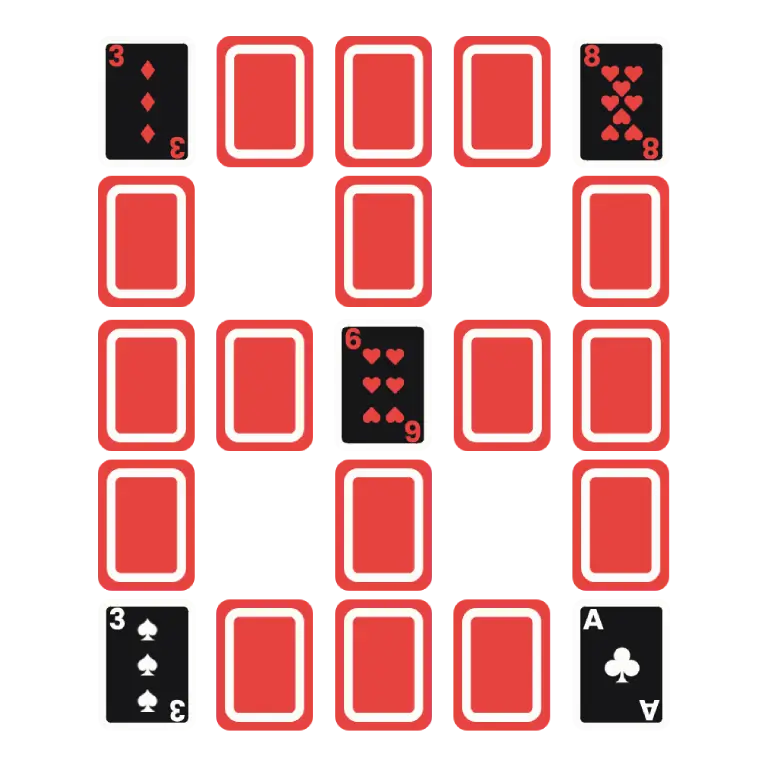
After that, the first player begins. Every time it is a player’s turn, they follow the four steps below:

Step 1. Choose a face-up card
Choose one of the face-up cards at the edges of the game. In the Squares variant, this can also be the face-up card in the middle.
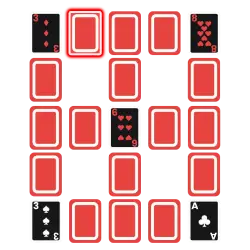
Step 2. Choose a face-down card
Now choose a card right next to it that is still face-down. You may only choose cards that are horizontally or vertically adjacent.
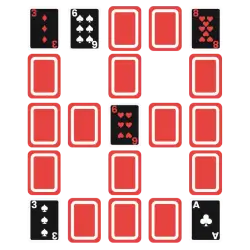
Step 3. Higher or Lower
State whether the face-down card has a higher or lower value than the face-up card. Then turn the face-down card over.
Step 4. Right or Wrong
Correct? Then it’s the next player’s turn. Wrong? Then you take a sip for every face-up card directly adjacent to the face-down card.
You will soon notice that the number of sips per wrong answer will start to increase. In the beginning, it will only be two or three sips, but as soon as you connect multiple corners or rows, the number rises rapidly. So choose strategically which card you pick.
Inside and Outside
While playing, you will quickly notice that sometimes you have a face-down card lying between two face-up cards. In that case, you don’t say whether the card is higher or lower, but whether it is ‘inside’ or ‘outside’ the values of the adjacent cards. The game continues until all cards have been revealed.
Frequently Asked Questions about Squares
How many players do you need for Squares?
You play Squares with a minimum of 2 players and a maximum of 12. Playing with a larger group is possible, but you might only get a turn once or twice, making the game less fun.
Do the cards stay on the table if you guess wrong?
Yes, in the original variant of the Squares rules they do, but as an expansion, you can choose to remove the connected cards instead. This makes the game a whole lot harder.
Which card do you choose when there are two face-up cards?
If there are two adjacent face-up cards next to a face-down card, you no longer choose higher or lower, but rather inside or outside the value of those two cards.
Squares Variants
Ready to turn Squares into pure chaos? If the standard rules are starting to bore you after a few rounds, we have extra rules and variants for you. These variants are the perfect way to speed up the game, make it harder, and crank the drinking factor up another notch.

Gas!
Playing Gas instead of Squares? Then it’s not the number of connected cards that counts, but the value of the card that determines the number of sips. Let’s hope you don’t draw an Ace..!
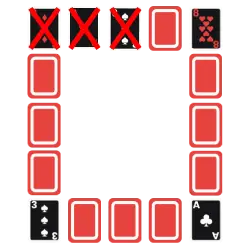
Removing Cards
In the event of a wrong guess, all cards connected to the wrong card are removed. For the starting face-up cards in the corners, you place a new face-up card back down.
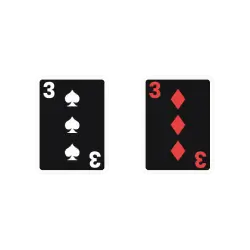
Pole (Same Card)
When the face-down card has the exact same value as the face-up card, it counts as correct, and to celebrate, all players must immediately take a sip.
Squares Strategy
Squares may be a pure game of chance, but you can still slightly increase your odds of winning. The difference between beginners and experts lies in understanding probability. Someone who guesses blindly has an average win chance of about 40-50%. But with the right knowledge, you can increase this to 65-75%. That’s the difference between drinking every round or winning with dry lips!
The Basics Higher/Lower
The higher/lower phase is the most common situation in Squares. You have one card next to you and must guess whether the next card is higher or lower. The trick is not to follow your gut feeling, but to trust the statistics.
| Card | Higher (%) | Lower (%) | Choice |
|---|---|---|---|
| 2 | 94.1% | 0% | Hoger |
| 3 | 86,3% | 7.8% | Hoger |
| 4 | 78,4% | 15.7% | Hoger |
| 5 | 70,6% | 23.5% | Hoger |
| 6 | 62.7% | 31.4% | Hoger |
| 7 | 54.9% | 39.2% | Hoger |
| 8 | 47.1% | 47.1% | Willkeurig |
| 9 | 39.2% | 54.9% | Lager |
| 10 | 31.4% | 62.7% | Lager |
| J | 23.5% | 70,6% | Lager |
| Q | 15.7% | 78,4% | Lager |
| K | 7.8% | 86,3% | Lager |
| A | 0% | 94.1% | Lager |
Card 8 is the “danger zone”, as the odds are almost 50/50 here. When in doubt, choose the side where fewer of those cards are already in play. Also, keep a “paaltje” (same value) in mind.
Inside/Outside Strategy
When you have two adjacent cards, you must guess whether the new card falls “inside” or “outside” the range. This is the second phase of the game and often harder than higher/lower, because you now have to work with two reference points instead of one.
Best Inside Scenarios (>50% chance)
- 2 and A: 86.3% chance (11 values in between) – almost all cards fall in between.
- 3 and K: 78.4% chance (10 values in between) – very safe bet.
- 4 and Q: 62.7% chance (8 values in between) – good bet.
- 5 and J: 54.9% chance (6 values in between) – slight preference for inside.
Dangerous Inside Scenarios (<50% chance)
- Consecutive cards (e.g., 7-8): 0% chance – ALWAYS choose outside.
- 1 value difference (e.g., 7-9): 7.8% chance (1 value in between: 8) – almost always outside.
- 2 values difference (e.g., 5-8): 15.7% chance (2 values in between: 6, 7) – choose outside.
- 3 values difference (e.g., 4-8): 23.5% chance (3 values in between: 5, 6, 7) – choose outside.
For inside/outside, the difference between the cards must be at least 5 for a good chance of ‘inside’. Smaller differences? Choose outside! This is a simple rule of thumb you can quickly apply while playing without complicated calculations.
Suit Strategy
With three or more adjacent cards, you have to guess the suit, which is immediately the hardest phase. With only a 25% chance, statistically, you will be wrong three out of four times. Luck plays a bigger role here than strategy, but you are not powerless. The best strategy? Avoid the suit phase by building smartly and drastically reducing the number of times you have to guess.
Tips
- Remember Visible Cards: Count how many cards of each suit you can already see on the board. Choose the suit you have seen the least.
- Avoid Recently Drawn Suits: If the last 2-3 cards were Hearts, the chance is slightly smaller that the next one will also be Hearts (fewer Hearts in the deck).
- Pattern Recognition: Although every draw is random, keeping track of the suit distribution can help. If many Spades have been drawn, there are fewer Spades left.
The suit phase is a pure guess (25% chance). Try to avoid this phase by smartly planning which spots you choose.